Is Rome a Bike-Friendly City?
Rome ranks 65th of 106 Italian cities for cycling — up 24 places in a year. What the 390 km of paths actually covers, where riding is genuinely good, and what is coming.
This question turns up in Google’s own “people also ask” box for practically every Rome cycling search, and the answer it deserves is not the one the tourist boards give.
No. Rome is not a bike-friendly city — and it is improving faster than almost any other in Italy.
Both halves of that are true and neither is the whole story.
The number
In Legambiente’s 2024 Urban Ecosystems report, Rome placed 65th out of 106 Italian cities. That is below halfway, in a country whose northern cities set a high bar.
The interesting part is the direction. The year before, Rome sat 89th. A jump of 24 places in twelve months put it ahead of Verona and Turin — cities with far better cycling reputations. Something is genuinely changing here, and it is changing quickly.
The 390 kilometres, and where they actually are
Rome has more than 390 kilometres of cycle paths, which sounds like a great deal until you look at the distribution.
Roughly half run through parks and along the Tiber and Aniene rivers. That is excellent infrastructure and it is not where the Pantheon is. The historic centre — the part every visitor wants to ride — is virtually devoid of official bike lanes.
This is the whole explanation for a paradox that confuses people planning a trip: how can a city this bad for cycling have this many five-star bike tours? Because a tour is a route, and a route can spend its entire length on the good half of that 390 km while still reaching the monuments.
Where Rome is genuinely good to ride
The Tiber path. Roughly 35 kilometres, from Castel Giubileo in the north to Mezzocammino in the south, running below street level and completely separated from traffic. It is the best piece of cycling infrastructure the city has, it passes straight through the middle of Rome, and most visitors never learn it exists.
The big parks. Villa Borghese, Villa Ada, Villa Doria Pamphili. Surfaced paths, no cars, gentle gradients. Villa Borghese is where Romans learn to cycle and has rental stands inside the gates.
The Appian Way. A regional park protecting the first 16 kilometres of a Roman road, with almost no traffic and a weekend restriction that removes most of what remains. It is a half-day of its own rather than part of a city ride — the surface is original basalt, which is why every guided bike tour out there runs electric bikes. appianwaybiketour.com covers the corridor, the vehicles and the catacomb closing days.
The pedestrianised zones and the early morning. Not infrastructure, but the same effect. Before about eight in the morning, and after dark, central Rome is a different city on a bike — which is precisely why the night ride is the most-reviewed evening product in town.
What is coming: the GRAB
The GRAB — Grande Raccordo Anulare delle Bici — is a 45-kilometre cycling loop around the historic centre, taking in the Colosseum, San Giovanni, the Appia Antica, Villa Ada and the university district. Construction began in July 2024, completion is expected in 2026, and it is funded by the Ministry of Infrastructure and Transport.
If it lands as designed it is the single biggest change to cycling in Rome in a generation: a continuous, protected ring connecting the parks, the river and the Appian Way. It is also the obvious explanation for that 24-place jump in the rankings.
Check its current state before planning a day around it. Large Italian infrastructure projects and their published completion dates are not always the same thing, and a half-finished loop is a different proposition from a finished one.
The two hazards nobody warns you about
Rome’s cycling reputation is all about traffic, and traffic is genuinely the biggest problem. But two others catch visitors out.
Sampietrini. The small squared basalt setts Rome paves with, laid by hand in fan patterns. They are among the most beautiful street surfaces in Europe and they are miserable on two wheels: constant vibration, gaps that catch a narrow tyre, and genuinely slippery when wet. This is the single reason wet-weather riding in Rome is a different activity rather than just a damper one.
Bike theft. A real and persistent problem, and it changes how a self-guided day works. Take a U-lock rather than a cable, and plan a ride with a few long stops rather than a dozen short ones. Rental practicalities are here.
So should you cycle in Rome?
Yes — on a route somebody else chose, or on the river and in the parks.
That is not a dodge, it is the actual answer. Rome punishes improvisation on a bike and rewards route knowledge more than almost any city in Europe. Either buy that knowledge, in the form of a guided ride, or spend your day on the two-thirds of the network that is already good and leave the centro storico to your feet.
What you should not do is rent a bike and try to thread the middle of Rome on instinct. That is the version of this day that goes wrong, and it is the version that gives the city its reputation.
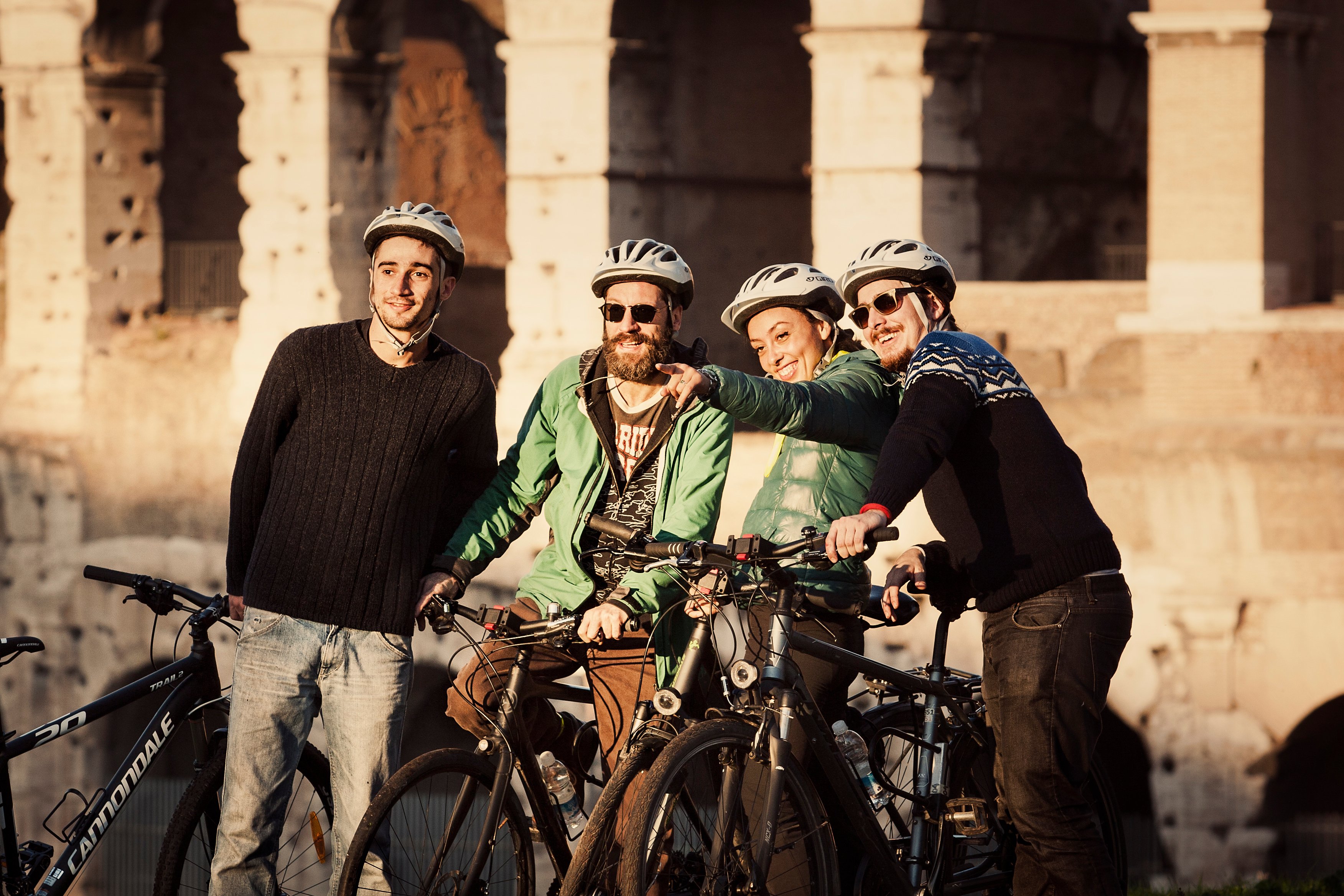
Let Someone Else Solve the Routing
Rome's cycling problem is knowing which streets to take, and that is exactly what a guided ride sells. The city's most-booked bike tour routes around the traffic entirely — rated 4.9/5 by 1,869 verified guests, from about $75.
Check Availability & Book